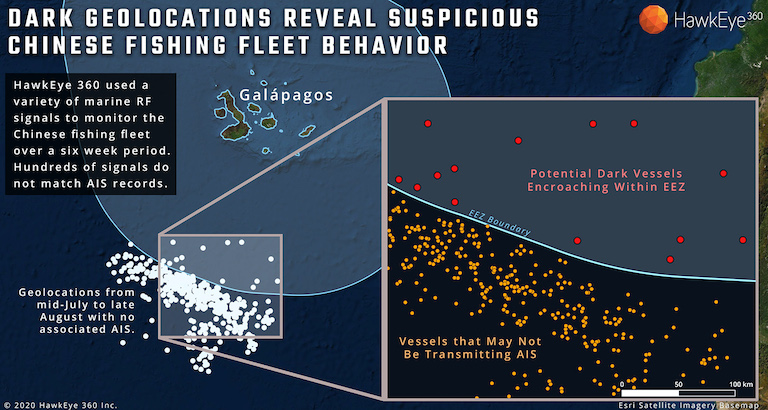
Hiina rannavalve ja kalalaevad on hakanud üle maailma erinevates kohtades jõupositsiooni kasutama. Saavad mitmel pool ka vastu aga kasvav trend on murettekitav. Näiteks Galapagose rannikuveed.
tsitaat:
Chinese fishing vessel attempted to ram Argentine Coast Guard ship after being ordered to leave Argentina’s EEZ. Coast Guard opened fire; the Chinese vessel fled.
Chinese belligerence must always be met with an even stronger response.
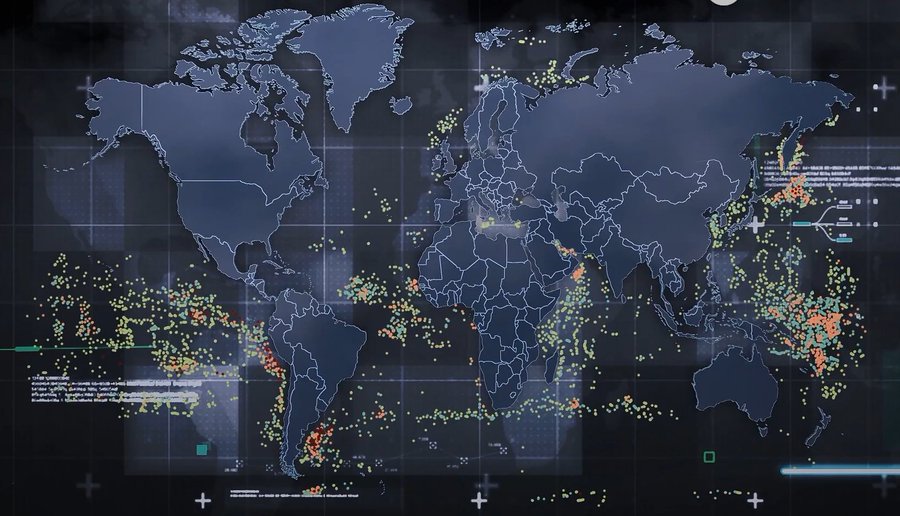
Hiina kalalaevad on muutunud ülemaailmseks probleemiks. Lisaks nende rannavalvelaevad, mis tungivad igapäevaselt riikide majandusvetesse ja neile mitte kuuluvatele aladele.
tsitaat:
China's state subsidized fishing fleet over fishes and uses damaging methods like Sea floor scraping,
These fleets also hide their locations and fish in the waters of foreign countries. This requires international attention as many governments cannot counter these fleets.
Kunagi oli selline mäng nagu Age of Empires II ... või noh, siiani on. Ja seal oli selline strateegia kalalaevadega, et said neid skautidena kasutada ja saata kusagile kaugesse kaardi nurka kalale. Hoidsid vaenlase tegevusel silma peal ilma, et vaenlane sind ründaks - sest noh, ohutud kalalaevad ju.
Mulle tundub, et Hiina mängib sarnast mängu.
The President of Finland, Alexander Stubb, has published an important article, “The West’s Last Chance,” arguing that the post–World War II order — built on cooperation, rules, and shared values — is breaking down. Wars are multiplying, alliances are fracturing, and rising powers across the global South are reshaping the geopolitical landscape.
This may be the West’s last chance to rebuild an international order that protects freedom, stability, and smaller nations like Ukraine. If the West fails, the alternative is a world governed by raw power — where aggression goes unpunished and borders mean nothing.
Key Points:
1. The old world order is collapsing.
The rules-based system that kept global peace for decades is unraveling under the pressure of wars, authoritarianism, and great-power competition.
2. A fragmented, multipolar world is emerging.
Influence is shifting to regional and “middle” powers — from India and Brazil to Turkey and Saudi Arabia — who no longer accept a Western-led system.
3. Global conflict is rising because institutions are failing.
The UN, EU, WTO, and other bodies lack the cohesion, authority, or legitimacy to stop aggression or resolve crises.
4. The West is dangerously divided.
Political polarization, inconsistent leadership, and short-term thinking weaken the ability of democracies to respond to global threats.
5. The global South feels ignored — and is choosing its own path.
Many countries believe the old system served Western interests, not theirs, and are now shaping alternative alliances and norms.
6. If the West does nothing, “might makes right” becomes the new global law.
A world where russia can invade neighbors, China redraws borders, and small countries lose basic security guarantees.
7. The West still has a narrow window to act.
Not to restore the old world, but to build a new one — inclusive, modernized, and capable of protecting sovereignty and stability.
8. The solution is renewed, reformed multilateralism.
Western democracies must modernize global institutions, bring rising powers into decision-making, and rebuild trust in shared rules.
9. Leadership matters: hesitation is fatal.
Without coordinated Western leadership, authoritarian regimes will reshape the global order in their image.
10. The stakes are existential for countries like Ukraine.
If the world shifts to a system where aggression is rewarded and sovereignty becomes negotiable, Ukraine will be the first — not the last — victim.
Kunagi oli selline mäng nagu Age of Empires II ... või noh, siiani on. Ja seal oli selline strateegia kalalaevadega, et said neid skautidena kasutada ja saata kusagile kaugesse kaardi nurka kalale. Hoidsid vaenlase tegevusel silma peal ilma, et vaenlane sind ründaks - sest noh, ohutud kalalaevad ju.
Mulle tundub, et Hiina mängib sarnast mängu.
Hiinal on kindel plaan Vaikne ookean oma kontrolli alla saada, ainuke kes saab seda takistada on Trump _________________ So, at the end of the day, after I have butchered all the nvidiots all around me, standing alone in a pool of blood surrounded by the corpses of my victims, a horrible truth reveals itself to me: I am an amd\ati fänboy...and I must do my dark masters bidding, for I am damned for all eternity...
Ei tee Trump midagi suurt seal selle 3 aastaga. USA oleks pidanud juba ammu hakkaba ressursse kõvasti panustama sellesse piirkonda, sest Hiina on pikalt seal enda infrat (ja ülemvõimu) ehitanud. Juba Obama rääkis, et Vaikne ookean ja see piirkond peab oleam USA peamine fookus, aga jutuks see jäi.
Aga eks loota annab, et usa ka reaalselt hakkab seal tegutsema pikemas ajaaknas, sest Hiina eelis erinevalt demokraatlike riikide ees on see, et nad teevad pikka mängu
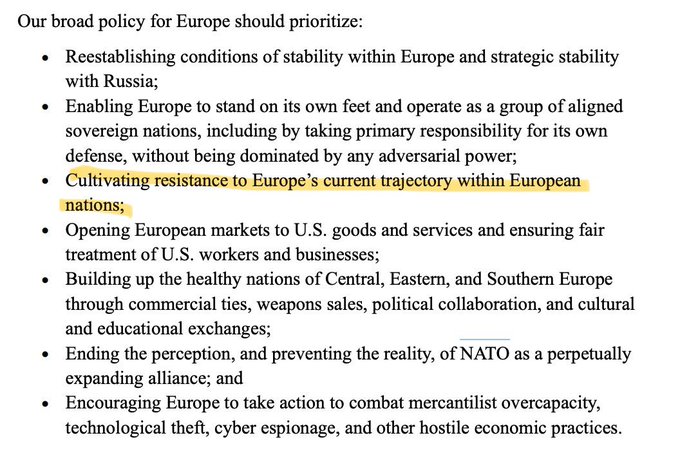
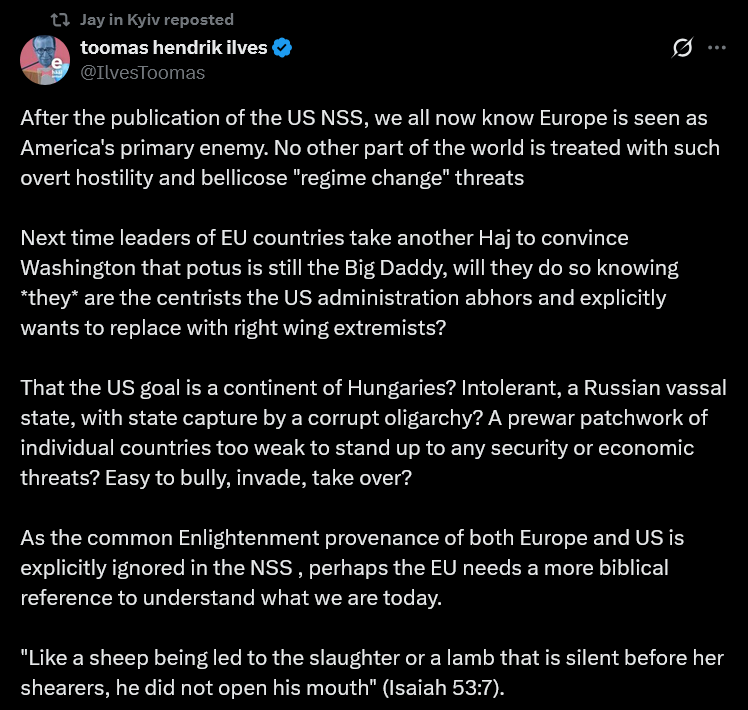
American officials have become used to thinking about European problems in terms of insufficient military spending and economic stagnation. There is truth to
this, but Europe’s real problems are even deeper.
Continental Europe has been losing share of global GDP—down from 25 percent in 1990 to 14 percent today—partly owing to national and transnational regulations
that undermine creativity and industriousness.
But this economic decline is eclipsed by the real and more stark prospect of civilizational erasure. The larger issues facing Europe include activities of the
European Union and other transnational bodies that undermine political liberty and sovereignty, migration policies that are transforming the continent and creating
strife, censorship of free speech and suppression of political opposition, cratering birthrates, and loss of national identities and self-confidence.
Should present trends continue, the continent will be unrecognizable in 20 years or less. As such, it is far from obvious whether certain European countries will have
economies and militaries strong enough to remain reliable allies. Many of these nations are currently doubling down on their present path. We want Europe to
remain European, to regain its civilizational self-confidence, and to abandon its failed focus on regulatory suffocation.
This lack of self-confidence is most evident in Europe’s relationship with Russia.
European allies enjoy a significant hard power advantage over Russia by almost every measure, save nuclear weapons. As a result of Russia’s war in Ukraine,
European relations with Russia are now deeply attenuated, and many Europeans regard Russia as an existential threat. Managing European relations with Russia
will require significant U.S. diplomatic engagement, both to reestablish conditions of strategic stability across the Eurasian landmass, and to mitigate the risk of
conflict between Russia and European states.
It is a core interest of the United States to negotiate an expeditious cessation of hostilities in Ukraine, in order to stabilize European economies, prevent
unintended escalation or expansion of the war, and reestablish strategic stability with Russia, as well as to enable the post-hostilities reconstruction of Ukraine to enable its survival as a viable state.
26
The Ukraine War has had the perverse effect of increasing Europe’s, especially Germany’s, external dependencies. Today, German chemical companies are
building some of the world’s largest processing plants in China, using Russian gas that they cannot obtain at home. The Trump Administration finds itself at odds with
European officials who hold unrealistic expectations for the war perched in unstable minority governments, many of which trample on basic principles of
democracy to suppress opposition. A large European majority wants peace, yet that desire is not translated into policy, in large measure because of those governments’
subversion of democratic processes. This is strategically important to the United States precisely because European states cannot reform themselves if they
are trapped in political crisis.
Yet Europe remains strategically and culturally vital to the United States. Transatlantic trade remains one of the pillars of the global economy and of
American prosperity. European sectors from manufacturing to technology to energy remain among the world’s most robust. Europe is home to cutting-edge
scientific research and world-leading cultural institutions. Not only can we not afford to write Europe off—doing so would be self-defeating for what this strategy
aims to achieve.
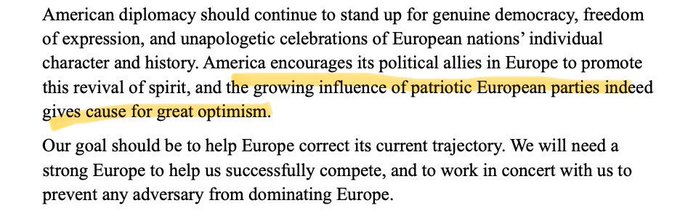
American diplomacy should continue to stand up for genuine democracy, freedom of expression, and unapologetic celebrations of European nations’ individual
character and history. America encourages its political allies in Europe to promote this revival of spirit, and the growing influence of patriotic European parties indeed
gives cause for great optimism.
Our goal should be to help Europe correct its current trajectory. We will need a strong Europe to help us successfully compete, and to work in concert with us to
prevent any adversary from dominating Europe.
America is, understandably, sentimentally attached to the European continent— and, of course, to Britain and Ireland. The character of these countries is also
strategically important because we count upon creative, capable, confident, democratic allies to establish conditions of stability and security. We want to work
with aligned countries that want to restore their former greatness.
Over the long term, it is more than plausible that within a few decades at the latest,
certain NATO members will become majority non-European. As such, it is an open
question whether they will view their place in the world, or their alliance with the
United States, in the same way as those who signed the NATO charter.
Ma kuulen esimest korda mingist FIFA rahupreemiast _________________ M: Intel i5 4590 protsessorid: 10€/tk M: HP Elitedesk 800 G3 SFF: 90€/tk M: HP Elitedesk 800 G2 Mini 35W: 90€/tk
Witkoffi juured on peamiselt Venemaal, kust on pärit nii tema ema- kui ka isapoolsed juudisoost esivanemad. Veri on paksem kui vesi. Ärihuvid veel lisaks.
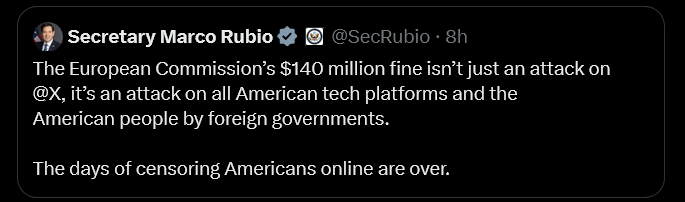
Seda konkreetset näidet ei oska kommenteerida, aga DSA tuleks endiselgt prügikasti saata. DSA häda on see, et see on nii ebamääraselt sõnastatud ja annab EU instantsidele vabad käed keda mille eest trahvida või tsenseerida. Ka "vale narratiivi" esitamine platvormil võib saada karistatud.
Today, the Commission has issued a fine of €120 million to X for breaching its transparency obligations under the Digital Services Act (DSA). The breaches include the deceptive design of its ‘blue checkmark', the lack of transparency of its advertising repository, and the failure to provide access to public data for researchers.
Inimestel on jätkuvalt sõnavabaduse ja tsensuuri definitsiooniga raskusi.
Kas keegi elmole juba on öelnud, et "Kuss, põssa!" (ma saan aru, et selle ütlemine on sõnavabadus ja kui keegi ta miniskuulsel egol natukene verbaalset sõnavabadust kasutab siis kontod kipuvad kaduma kiirelt?)
No loe artiklit. UK hakkas USA-le ettekirjutama, mida USA kodanikud võivad oma USA portaalis kirjutada.
Kui UK oma trahvinõudmisest ei tagane, ei jää portaalidel muud üle kui riigipõhiselt ligipääsu piirata.
Paraku on ameeriklastel Euroopa ahistamisest ja trahvimisest kopp ees.
Ja mitte vaid MAGA seltskonna seas. Lisaks, bürokraatlik ja ahistav DSA puudutab ka Euroopa firmasid.
Meie Brüsseli idikatest ametnikud muidugi ei adu, milliste geopoliitiliste murranguteni sellised sammud viivad.
Ma üldse ei imesta, et USA-l on Euroopa käitumisest kopp ees. Trans-atlantalise liidu lagunemine on väikesele Eestile kõige hullem. Putler tahaks kindlasti proovile panna NATO ühtsust. _________________ Hinnavaatlus.ee - leia parim hind! HV-s ID-kaardiga autentimine
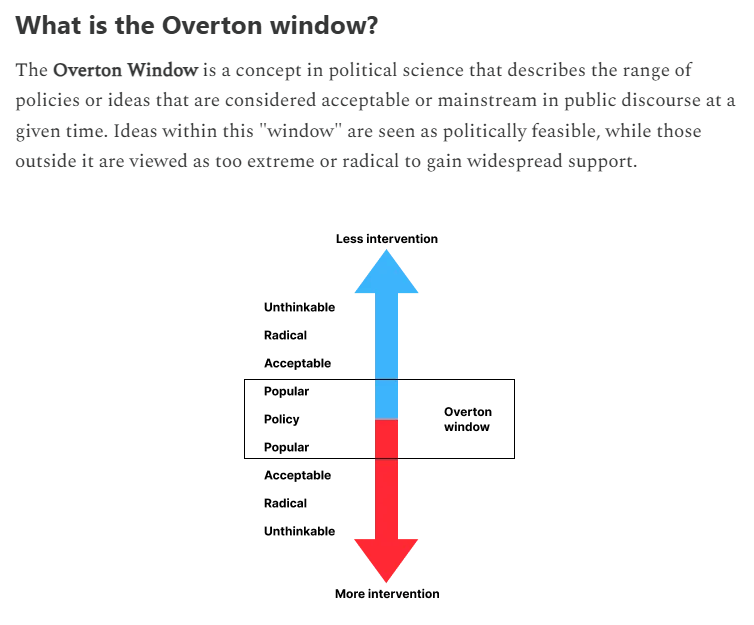
The Overton Window is a concept in political science that describes the range of policies or ideas that are considered acceptable or mainstream in public discourse at a given time.
Ideas within this "window" are seen as politically feasible, while those outside it are viewed as too extreme or radical to gain widespread support.
The Overton Window is a concept in political science that describes the range of policies or ideas that are considered acceptable or mainstream in public discourse at a given time.
Ideas within this "window" are seen as politically feasible, while those outside it are viewed as too extreme or radical to gain widespread support.
UK ei ole küll EL, aga kujutage ette, kui suurimad sotsiaalmeedia portaalid keeravad ligipääsu eurooplastele kinni mingite jaburate nõuete tõttu.
OMG, inimestelt võetakse juurdepääs internetiprügikastile? _________________ All it took was for a lot of seemingly decent people to put the wrong person in power, and then pay for their innocent choice.
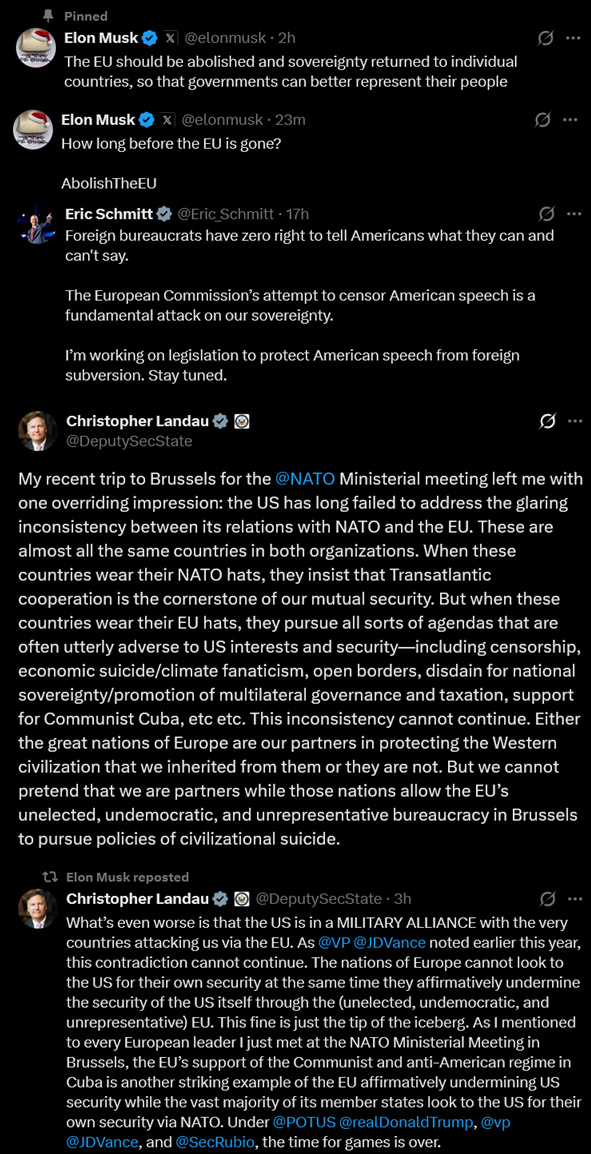
A few of us have been warning about this illogical and, in many ways, unnatural drift in European institutions and in some governments. We’ve been mocked, dismissed as crazy, conspiracists, and cranks. Yet reality has a way of highlighting what should have been obvious all along: it makes no sense to keep funding contradictions while neglecting urgent and legitimate causes.
We need to realign our priorities. The money that has been sent to Cuba over the years should be redirected to support Ukrainians. The money that has gone toward supporting, directly or indirectly, totalitarian regimes in different parts of the world, especially in Latin America, should instead be used to confront criminal regimes and narco-dictatorships that hollow out societies from within. And the political and legislative energy we have spent pressuring other countries to adopt certain “approved” agendas and frameworks should be redirected toward a serious strategy: standing with those who fight for freedom, the rule of law, and security and pushing back against those who survive on repression and are financed by organized crime.
Et siis see, kui USA suurkorporatsioonid EU-s sisuliselt makse ei maksa, vilistavad siin kehtivatele seadustele ja kasutavad oma sotsiaalmeedia platvorme siinse poliitika mõjutamiseks, on OK. Kui EU lõpuks ometi midagi sellele ülbusele vastu teeb, on not OK. Samal ajal USA administratsioon keerab Euroopale igast asendist kõigil võimalikel viisidel, aga süüdi on Euroopa.
Endise twitteri võiks EU juba ennetavalt ära bännida.
A few of us have been warning about this illogical and, in many ways, unnatural drift in European institutions and in some governments. We’ve been mocked, dismissed as crazy, conspiracists, and cranks. Yet reality has a way of highlighting what should have been obvious all along: it makes no sense to keep funding contradictions while neglecting urgent and legitimate causes.
We need to realign our priorities. The money that has been sent to Cuba over the years should be redirected to support Ukrainians. The money that has gone toward supporting, directly or indirectly, totalitarian regimes in different parts of the world, especially in Latin America, should instead be used to confront criminal regimes and narco-dictatorships that hollow out societies from within. And the political and legislative energy we have spent pressuring other countries to adopt certain “approved” agendas and frameworks should be redirected toward a serious strategy: standing with those who fight for freedom, the rule of law, and security and pushing back against those who survive on repression and are financed by organized crime.
Thanks.
Kõigepealt taome rusikaga rindu, levitame kremli propagandat ja nõuame §1. Kui see samune §1 on ohus, nõuame, et kohitsetud ja hambutu Majandusühendus meid kaitseks. Nüüd, kui Majandusühendus üritab proteesidega hammustada, jälle ei sobi...
---
-Kaivo- kirjutas:
nah twitter on vajalik. Seal liigub infot.
Palun ära ole naiivne _________________ All it took was for a lot of seemingly decent people to put the wrong person in power, and then pay for their innocent choice.
Nagu siin kunagi sai öeldud, et Euroopa suured on alati põlgusega USA suunas vaadanud. Eelkõige välispoliitika suunas. Aga neil on Ameerikat vaja, eelkõige erinevad toetustemehhanismid, mistõttu kutsutakse seda suureks ja "parimaks" sõbraks. Ja ka nüüd jätkub see (vt Kallase öeldut).
See, et Euroopa selliseid lollusi nagu DSA (või Chat Control) läbi surub on äärmiselt debiilne. Aina enam meenutab EU ühte vana liitu uues kuues ja saab esitada küsimusi, miks suuri korpe siin mandril enam sisuliselt pole (millele noorem Villig tähelepanu juhtis).
Reaalsus on selline, et Euroopa pehmod (peavoolu poliitilised jõud) ei ole siiani otsustavaid samme julgeoleku tagamiseks astuda, vaid ainult oskavad piirata ja reguleerida. _________________ Hinnavaatlus.ee - leia parim hind! HV-s ID-kaardiga autentimine
Rahvuslased on vingunud nagu sead aiavahel iga kord kui EU midagi üritab.
Maa külmand või kärss kärnas.
Eesti kohalikud levitavad väga orbani vaibi igapäevaselt. Noh, koguaeg on karuvõileib sees v.a. siis kui tahetakse et nende heaks midagi keegi teeks. Siis on kõik pahad ja ei aita, arusaamata, et nad igapäevaselt kõiki teisi p*rse saates ainult võimendavad oma kajakambrit.
Kindlasti ei föderaalsele Euroopale, Eesti suguse väikeriigi suveräänsusest ei jääks enam midagi alles. Tugev, rahvusriikide majandusliit on ainus lahendus.
Rohepööre, kui konkurentsivõimet ja majandust hävitav ideoloogiline liikumine tuleb peatada ja energiahinnad vabaks lasta (peatada vähemalt ajutiselt CO2 kvootide süsteem) - vabanenud vahendid suunata Ukraina ja Euroopa kaitsevõime tugevdamisse. _________________ Hinnavaatlus.ee - leia parim hind! HV-s ID-kaardiga autentimine
Ja lisaks ääremärkusena, et nii kaua kui pole föderaalset Euroopat, pole sellest piirkonnast ka konkurenti USA-le. Aga muidu nõus - meil on liiga erinevad majandus, kultuuri ja keeleruumid siin, et see kunagi juhtuks.
Rahvuslased on vingunud nagu sead aiavahel iga kord kui EU midagi üritab.
Maa külmand või kärss kärnas.
Eesti kohalikud levitavad väga orbani vaibi igapäevaselt. Noh, koguaeg on karuvõileib sees v.a. siis kui tahetakse et nende heaks midagi keegi teeks. Siis on kõik pahad ja ei aita, arusaamata, et nad igapäevaselt kõiki teisi p*rse saates ainult võimendavad oma kajakambrit.
Ma kah ei saa aru, miks sa Trumpi üle kogu aeg ilgud. Meie endi liitlane ja sa mõnitad teda erinevate nimedega.
Kindlasti ei föderaalsele Euroopale, Eesti suguse väikeriigi suveräänsusest ei jääks enam midagi alles. Tugev, rahvusriikide majandusliit on ainus lahendus.
Rohepööre, kui konkurentsivõimet ja majandust hävitav ideoloogiline liikumine tuleb peatada ja energiahinnad vabaks lasta (peatada vähemalt ajutiselt CO2 kvootide süsteem) - vabanenud vahendid suunata Ukraina ja Euroopa kaitsevõime tugevdamisse.
Kuidas sa seda ette kujutad, majandusliit ja tugev kaitsevõime?
Nagu ma aru saan, siis Belgias külmutatud kremli rahade kasutamine seisab puht juriidiliste probleemide taga. Majandusliit ei anna Beligale siin mingeid garantiisid.
Tugev kaitse saab toimuda ainult siis, kui valitseb ühtne õigusruum. Muul juhul ei ole võimalik, et näieks Prantsusmaa või Poola üksused läbi naaberriigi liiguksid.
Seda "majandusliitu" kasutavad kenasti ära Hollandi kriminaalid, kes käivad Saksamaal pangaautomaate röövimas. Saksamaa politsei jälitab neid täpselt Saksamaa piirini.
Seega tugev majandusliit tähendab sisuliselt föderatsiooni, sest õigusruumist peab olema ühtlustatud, sest muul juhul ei ole tugev majandusliit võimalik.
See rahvusriikide kontseptsioon on 17-18 saj pärit väljamõeldud konstruktsioon.
Euroopa probleem ei ole kindlasti mitte rohepööre vms, vaid sotsiaalsüsteem, mis neelab arvestatava osa eelarvest ning millest inimesed keelduvad loobumast. _________________ All it took was for a lot of seemingly decent people to put the wrong person in power, and then pay for their innocent choice.
Sellise jutu peale pole tiblasid vajagi. Saate mõlemad omadelt kuuli. Päris hullu teksti tuleb - vihkame oma rahvust, sest natsid ja tiblad _________________ M: Intel i5 4590 protsessorid: 10€/tk M: HP Elitedesk 800 G3 SFF: 90€/tk M: HP Elitedesk 800 G2 Mini 35W: 90€/tk
sa ei või postitada uusi teemasid siia foorumisse sa ei või vastata selle foorumi teemadele sa ei või muuta oma postitusi selles foorumis sa ei või kustutada oma postitusi selles foorumis sa ei või vastata küsitlustele selles foorumis sa ei saa lisada manuseid selles foorumis sa võid manuseid alla laadida selles foorumis
Hinnavaatlus ei vastuta foorumis tehtud postituste eest.


 :: KKK
:: otsing
:: KKK
:: otsing  :: statistika
:: kasutajate nimekiri
:: kasutajate grupid
:: registreeri
:: statistika
:: kasutajate nimekiri
:: kasutajate grupid
:: registreeri













 teata moderaatorile






 Spoiler


 Aga muidu nõus - meil on liiga erinevad majandus, kultuuri ja keeleruumid siin, et see kunagi juhtuks.