Trump ise väidab, et tema ja Putin vestlesid üle kahe tunni. Hiljem ajakirjandusega vesteldes ütles Trump ka, et Putin lubab aidata Ukrainat üles ehitada ja pakkuda riigile odavat energiat.
„Venemaa tahab näha Ukrainat edu saavutamas. See kõlab veidi kummaliselt, aga ma selgitasin seda presidendile (Zelenskõi toimetaja märkus). President Putin oli oma soovides Ukraina edu saavutamiseks väga helde,“ ütles Trump.
Zelenskõi vaikis ja naeratas, kui Trump esitas Venemaa presidendi, kes ründas Ukrainat 2022. aasta veebruaris, väite. Konflikt on nüüdseks Euroopas ohvriterohkeim pärast Teist maailmasõda.
äoIHGIPfr7t 9ü80õw90'
Sarah Longwell on Trumpi-kriitilise ja konservatiivse veebisaidi The Bulwark toimetaja.
- Kui ma tõesti tahan, et mu naabril läheks hästi, siis ma murran tema majja sisse. Ma kohtlen tema perekonda jõhkralt. Varastan ta lapsed ja põletan maja maha, karjudes samal ajal: "Mees, ma lihtsalt üritan aidata!" Meie president on rahvusvaheline katastroof, kirjutab ta X- is .
The latest numbers represent a decline from 2024, when Medvedev said roughly 450,000 people signed military contracts and 40,000 joined volunteer units.
This year’s decrease in recruitment numbers has coincided with several Russian regions scaling back one-time enlistment bonuses for men signing contracts.
1100-1200 päevas kattub "juhuslikult" Ukraina kindralstaabi ohvrite numbritega.
Kui 1000+ iga päev lahingus ei lange (surnud+vigastatud) ja venelase värvatavad on aastas tõesti 400k+, siis miks on venelaste armee suurus Ukraina okupeeritud aladel ikka umbes 700k kandis?
Loogika ütleb, et selliste värbamisnumbrite juuures, kui kaotused tõesti pole 1000+ päevas nagu "isemõtlejad" siin on viidanud peaks neil siis olema juba mitme miljoniline armee seal pärast nelja aastat sõda.
Aga ei ole ju. Nad isegi ei valeta justkui oleks.
Küllap mõnel tüübil ikka see "military contract" aegus ka ja kõik ei saanud surma.
Ega koguaeg ka ei ole 1000+ olnud aga keskmine on viimasel ajal seal lähedal olnud küll.
Päris jube mõelda. Ja kas nüüd lähinädalatel ei saa venemaa aktsioon Ukrainas alates 2022 olema juba pikemalt kestnud kui kogu idarinne II MS ajal?
tsitaat:
the Eastern Front (Great Patriotic War) ran for about 1,418 days (June 22, 1941–May 9, 1945)
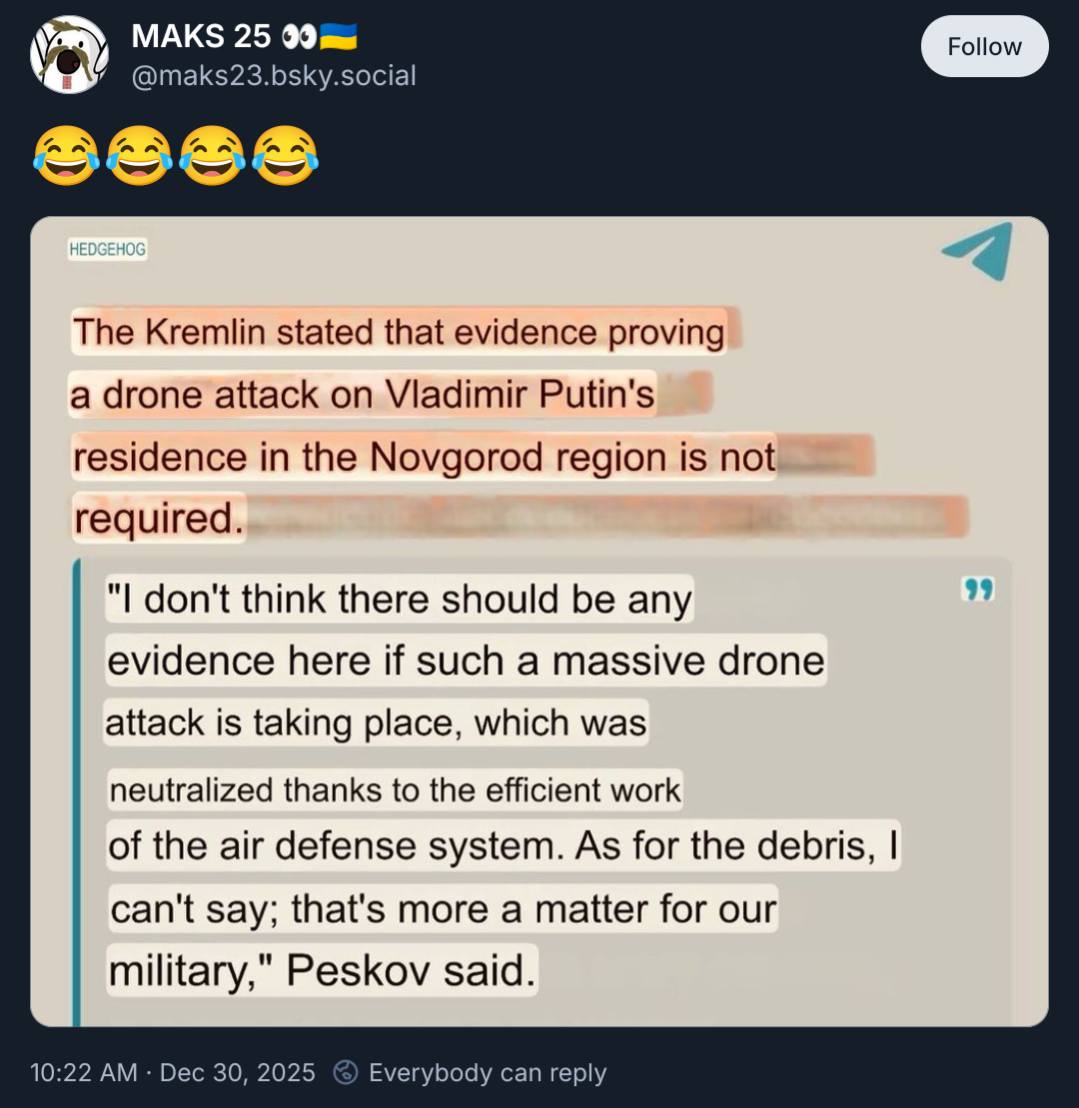
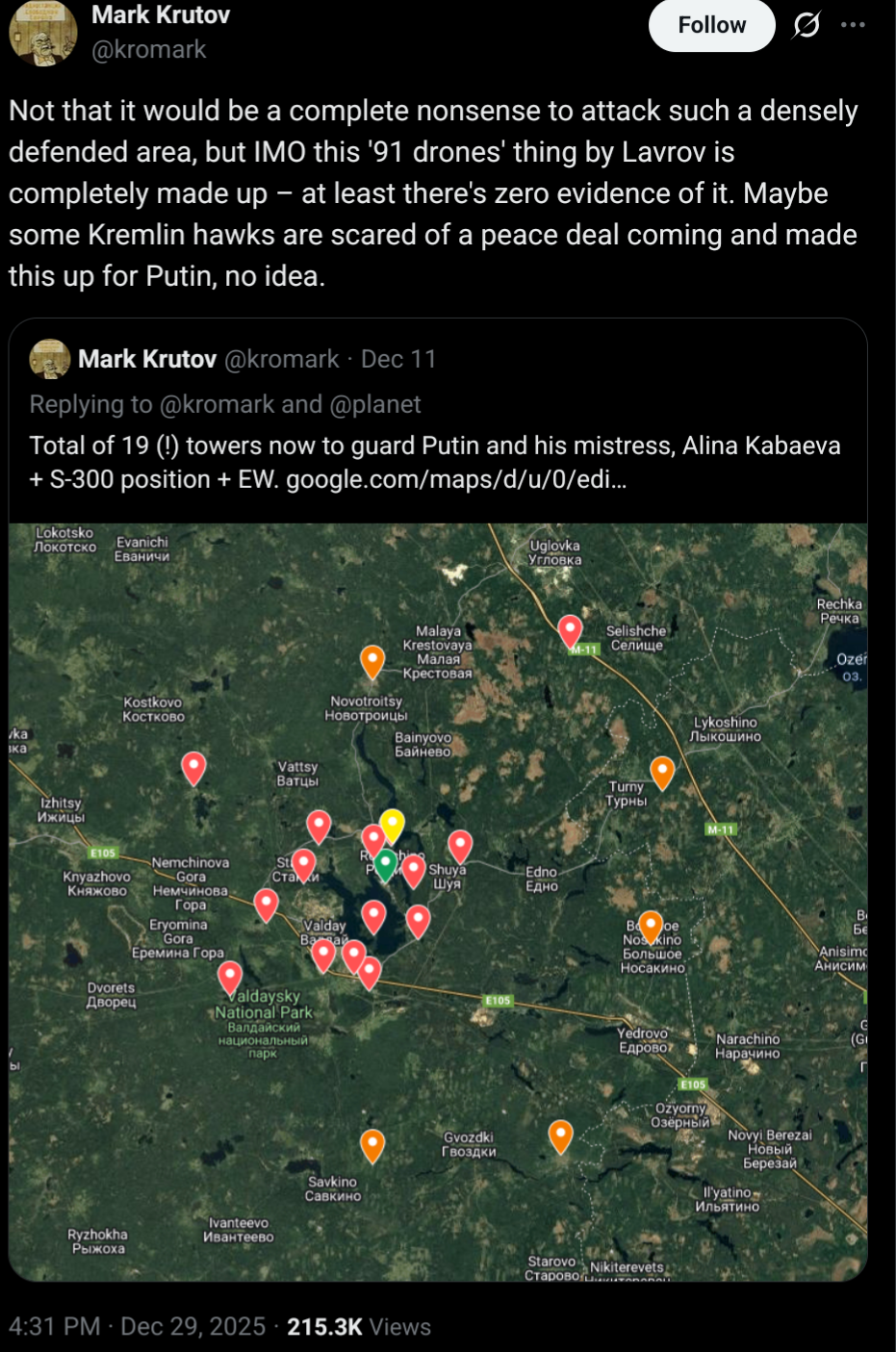
Ukraine attempted to attack a residence belonging to Russian President Vladimir Putin in the Novgorod region, IFX reports. Russia will retaliate and will change its negotiating position, Russian Foreign Minister Sergei Lavrov said, according to TASS.
tsitaat:
Russia is preparing strikes on government buildings in Kyiv, President Zelensky said.
He also denied claims of a direct Ukrainian attack on Putin’s residence, calling the allegations “a lie.”
tsitaat:
Trump was “shocked and outraged” by the alleged attempt to attack Putin’s residence, according to Yuri Ushakov, an aide to the Russian president.
Kremlin aide Ushakov claims Trump told Putin: “Thank God we didn’t give Zelensky Tomahawk missiles.”
The American approach to working with Zelenskyy will change after this attack: this is what Trump told Putin,
Iraanis mitmendat päeva protestid raha, vee jms pärast. Oleks muidugi hea, kui praegune usklik režiim kokku kukuks, aga hetkel ei tundu see veel usutav, kuni nn eliitpolitsei neid toetab. Tavapolitsei seas on näha protesti pooldajaid.
The United Arab Emirates called for “restraint and wisdom” Tuesday after Saudi Arabia accused it of backing an offensive by separatists in Yemen, while disputing Riyadh’s allegations against it.
The UAE Foreign Ministry’s statement followed Saudi Arabia launching airstrikes on Yemen’s port city of Mukalla, where the kingdom asserted that the UAE shipped armored vehicles and weapons.
...
tsitaat:
Kremlin spokesperson Dmitry Peskov said that Russia’s peace talks will now be conducted only with the United States, adding that Moscow’s position will harden.
Iraanis mitmendat päeva protestid raha, vee jms pärast. Oleks muidugi hea, kui praegune usklik režiim kokku kukuks, aga hetkel ei tundu see veel usutav, kuni nn eliitpolitsei neid toetab. Tavapolitsei seas on näha protesti pooldajaid.
Betamax, Kui vee ja rahakriis piisavalt tõsiseks läheb on järgmine süüria valmis niikuinii ja siis pole enam vahet kes seda juhtida üritab.
Kui praegused tõsiusklikud võimult kihutatakse, siis on vähemalt võimalus, et uus valitsus üritab midagi paremaks muuta ja ehk ka läänega suhteid normaliseerida. venemaa kaotaks samuti järjekordse liitlase. _________________ Win11 25H2 upgrade skriptid neile kelle masin ise ei taha 23H2 või 24H2 pealt ennast uuendada: https://foorum.hinnavaatlus.ee/viewtopic.php?p=11720738#11720738
Youtube lisa vene jama eemaldamiseks: https://foorum.hinnavaatlus.ee/viewtopic.php?p=11745846#11745846
The crew of an oil tanker fleeing U.S. forces in the Atlantic Ocean recently painted a Russian flag on the side of the vessel, in an apparent attempt to claim Russian protection, two American officials said on Tuesday.
It’s the latest twist in a bizarre odyssey that began on Dec. 21 when the U.S. Coast Guard tried to intercept the ship, Bella 1, in the Caribbean Sea as it sailed toward Venezuela to pick up oil, putting it in the cross hairs of President Trump’s quasi-blockade of the Venezuelan government’s economic lifeline.
The Bella 1’s crew members have since painted a Russian flag on the tanker during the escape and are now claiming Russian status, according to the U.S. officials, who were briefed on the matter and spoke on condition of anonymity to discuss a sensitive operation.
The tanker has been under U.S. sanctions since last year for transporting Iranian oil, which federal authorities have said is sold to finance terrorism.
Kuna 2025. aastal USA presidendi Donald Trumpi administratsiooni surve all rahupüüdlused intensiivistusid, avaldati Venemaa allikates 40% rohkem sõdurite nekrolooge võrreldes eelmise aastaga.
https://www.bbc.com/news/articles/c62n922dnw7o
The number of obituaries for any given period is a preliminary estimate of the confirmed losses, as some need additional verification and will eventually be discarded. But it can indicate how the intensity of fighting is changing over time.
Kuulduste kohaselt ei saa tallinans s*tal käia, vett ei ole
Kuulduste järgi, krabataks poes pudelivett ja Lasnamäel ning Mustakal on kraanid kuivad. _________________ ...life is random...so am I...
So, there is a fan. Time to grab your sh*t, gentlemen!
Uudiseid uskudes on ka Õismäe juba kuival.
Nüüd jääb üle veel elektri blackouti oodata ja oleks täiuslik. _________________ ...life is random...so am I...
So, there is a fan. Time to grab your sh*t, gentlemen!
Hea, et maal olen. Saan vajadusel segamatult kuuse all käia. _________________ M: Intel i5 4590 protsessorid: 10€/tk M: HP Elitedesk 800 G3 SFF: 90€/tk M: HP Elitedesk 800 G2 Mini 35W: 90€/tk
Mustakal, lähen panen pesu pessu, ise pessu ja kraanivesi jooksma
Uudis kamdelfis, kus süüdi erakordsed ilmaolud ja järvejää Järvejäääääääää ja erakordsed ilmaolud.... Mis meil saab, kui -10 õues, kogu Eesti veevärk seisab või? _________________ M: korter Mustamäel YAGA müügiputka
See veesurve kadu algas jah juba kuskil enne õhtut. Ära ei kadunud, aga nirises. Läksin kohe uudist otsima, aga meil on ju nii operatiivne meedia, et uudised tekivad mitmetunnise hilinemisega.
Õnneks pudeli ja kraanivee varu on olemas. Potil sai kah juhuslikult ära käidud enne seda. Isegi nõud said pestud. _________________ Win11 25H2 upgrade skriptid neile kelle masin ise ei taha 23H2 või 24H2 pealt ennast uuendada: https://foorum.hinnavaatlus.ee/viewtopic.php?p=11720738#11720738
Youtube lisa vene jama eemaldamiseks: https://foorum.hinnavaatlus.ee/viewtopic.php?p=11745846#11745846
telegra.ph ütles, et liiga suur. (That's what she said)
Spoiler
What followed was nearly a year of on-again, off-again negotiations, apportioning of territory, administration infighting and a war still without end. This is the story of how it unfolded.
What followed was nearly a year of on-again, off-again negotiations, apportioning of territory, administration infighting and a war still without end. This is the story of how it unfolded.
The Separation:
Inside the Unraveling U.S.-Ukraine Partnership
As President Trump sought a peace deal and Vladimir V. Putin sought victory, factions in the White House and Pentagon bled the Ukrainian war effort.
By Adam Entous
Adam Entous conducted more than 300 interviews over more than a year with government, military and intelligence officials in Ukraine, the United States, Britain, Belgium, Germany, Estonia, Poland, Latvia, Lithuania and Turkey.
Dec. 30, 2025
The train left the U.S. Army depot in the west of Germany and made for Poland and the Ukrainian border. These were the final 800 miles of a trans-Atlantic supply chain that had sustained Ukraine across more than three long years of war.
The freight on this last day in June was 155-millimeter artillery shells, 18,000 of them packed into crates, their fuses separated out to prevent detonation in transit. Their ultimate destination was the eastern front, where Vladimir V. Putin’s generals were massing forces and firepower against the city of Pokrovsk. The battle was for territory and strategic advantage but also for bragging rights: Mr. Putin wanted to show the American president, Donald J. Trump, that Russia was indeed winning.
Advertising their war plan, the Russians had told Mr. Trump’s advisers. “We’re going to slam them harder there. We have the munitions to do that.” In Washington, the defense secretary, Pete Hegseth, had been talking about munitions, too, testifying to a Senate appropriations subcommittee that those earmarked for Ukraine by former President Joseph R. Biden Jr. were “still flowing.”
Three months earlier, in fact, Mr. Hegseth had, unannounced, decided to hold back one crucial class of munitions — American-made 155s. The U.S. military’s stocks were running low, his advisers had warned; withholding them would force the Europeans to step up, to take greater responsibility for the war in their backyard.
Day after day, then, thousands upon thousands of 155s earmarked for Ukraine had lain waiting on pallets at the ammunitions depot. The American commander in Europe, General Christopher G. Cavoli, had fired off email after email, pleading with the Pentagon to free them. The jam had been broken only after intervention from Jack Keane, a retired Army general and Fox News contributor who was friendly with the president.
But on July 2, as the train approached the Ukrainian border, a new order came in to the U.S. military’s European Command: “Divert everything. Immediately.”
Exactly why the liberated shells had been taken captive again was never explained. In the end, they waited for just 10 days, in a rail yard near Krakow. Yet to U.S. military officers who had spent the last three and a half years fighting to shore up the Ukrainian cause, the interrupted journey of the 18,000 shells seemed to encompass the entirety of America’s new, erratic and corrosive role in the war.
“This has happened so many times that I’ve lost count,” a senior U.S. official said. “This is literally killing them. Death by a thousand cuts.”
A man in an apron and work gloves holding an artillery shell.
A worker handling a 155-millimeter artillery shell, a key munition provided to Ukraine, at the Scranton Army Ammunition Plant in Pennsylvania last year.
It was to hold back the Russian tide, perhaps even help win the war, that the Biden administration had provided Ukraine with a vast array of increasingly sophisticated weaponry. The Americans, their European allies and the Ukrainians had also joined in a secret partnership of intelligence, strategy, planning and technology, its workings revealed earlier this year by The New York Times. At stake, the argument went, was not just Ukraine’s sovereignty but the very fate of the post-World War II international order.
Mr. Trump has presided over the partners’ separation.
The headlines are well known: Mr. Trump’s televised Oval Office humiliation of the Ukrainian president, Volodymyr Zelensky, in February. The August summit with Mr. Putin in Alaska. The furious flurry of diplomacy that led to the Mar-a-Lago meeting on Sunday with Mr. Zelensky, the latest high-stakes but inconclusive negotiation in which the fate of Ukraine has seemed to hang in the balance.
It is still unclear when, and if, a deal will be reached. This is the chaotic and previously untold story behind the past year of head-spinning headlines:
The Ukraine specialists at the Pentagon afraid to utter the word “Ukraine.” Mr. Trump telling his chosen envoy to Russia and Ukraine, “Russia is mine.” The secretary of state quoting from “The Godfather” in negotiations with the Russians. The Ukrainian defense minister pleading with the American defense secretary, “Just be honest with me.” A departing American commander’s “beginning of the end” memo. Mr. Zelensky’s Oval Office phone call, set up by the president, with a former Miss Ukraine.
This account draws on more than 300 interviews with national security officials, military and intelligence officers and diplomats in Washington, Kyiv and across Europe. Virtually all insisted on anonymity, for fear of reprisal from Mr. Trump and his administration.
Mr. Trump had scant ideological commitment. His pronouncements and determinations were often shaped by the last person he spoke to, by how much respect he felt the Ukrainian and Russian leaders had shown him, by what caught his eye on Fox News.
Policy was forged in the clash of bitterly warring camps.
Mr. Biden had left the Ukrainians a financial and weapons nest egg to cushion them for an uncertain future. Mr. Trump’s point man for peace negotiations presented him with a plan to maintain support for Ukraine and squeeze the Russian war machine.
But that strategy ran headlong into a phalanx of Ukraine skeptics led by the vice president, JD Vance, and like-minded officials he seeded at the Pentagon and elsewhere in the administration. In their view, instead of squandering America’s depleted military stocks on a sinking ship, they should be reapportioned to counter the greatest global threat: China.
A cold wind — what one senior military officer called “a de facto anti-Ukraine policy” — swept through the Pentagon. Time and again, Mr. Hegseth and his advisers undermined, sidelined or silenced front-line generals and administration officials sympathetic to Ukraine.
Against that backdrop, Mr. Trump granted Mr. Hegseth and other subordinates wide latitude to make decisions about the flow of aid to Ukraine. On several occasions, when those decisions brought bad press or internal backlash — as with the 18,000 shells — Ukraine-friendly commentators at Fox stepped in and persuaded the president to reverse them.
Even as Mr. Trump bullied Mr. Zelensky, he seemed to coddle Mr. Putin. When the Russian stiff-armed peace proposals and accelerated bombing campaigns on Ukrainian cities, Mr. Trump would lash out on Truth Social and ask his aides, “Do we sanction their banks or do we sanction their energy infrastructure?” For months, he did neither.
But in secret, the Central Intelligence Agency and the U.S. military, with his blessing, supercharged a Ukrainian campaign of drone strikes on Russian oil facilities and tankers to hobble Mr. Putin’s war machine.
Day to day, Mr. Trump was inconsistent. But he was still a deal maker determined to broker a deal — and convinced that, in the calculus of leverage, the advantage lay with the stronger. Both sides fought a war within the war, to shape the president’s perceptions. “They look invincible,” he told aides in May after seeing footage of a military parade in Moscow. Three weeks later, after Ukraine mounted an audacious covert drone operation inside Russia, Mr. Zelensky sent a parade of aides to the White House with his own victory message: “We are not losing. We are winning.”
Yet on the battlefield and at the negotiating table, Mr. Trump kept pushing the Ukrainians deeper and deeper into a box. What he underestimated was the Russian leader’s refusal to budge from his demands.
The origin point of this story was the president’s belief in what he saw as his personal connection to Mr. Putin. On the campaign trail, he had promised to broker peace quickly, perhaps even before taking office. After he won the election, European and Middle Eastern leaders began calling, offering to help smooth the way for talks with the Russians during the transition.
Mr. Trump’s aides knew he was eager to get started, but they were also aware of the shadow that outreach to Russia had cast over his first term. Then, several aides’ undisclosed contacts with the Russians before the inauguration had become part of the investigation of Russian interference in the 2016 election. Mr. Trump took to bitterly calling it “the Russia, Russia, Russia hoax.”
This time, his aides decided, they needed official cover.
“Look, we’ve been getting all kinds of outreach,” Mr. Trump’s pick for national security adviser, Michael Waltz, told his Biden administration counterpart, Jake Sullivan. “We’d like to go ahead and start testing some of these, because Trump wants to move quickly.”
And so Mr. Waltz made a request, never before reported, for a letter of permission from Mr. Biden.
A wrecked tank on a blackened roadside.
A Ukrainian tank that was struck by a drone a few miles from the Kursk region of Russia.
Finbarr O'Reilly for The New York Times
Part 1
The Transition
U.S.
Lloyd J. Austin III
Def. Sec.
Joseph R. Biden Jr.
President
Keith Kellogg
Envoy
Jared Kushner
Adviser
Donald J. Trump
President
J.D. Vance
Vice Pres.
Michael Waltz
Nat. Sec.
Susie Wiles
Staff Chief
Steve Witkoff
Envoy
Russia
Kirill Dmitriev
Wealth Fund
Vladimir V. Putin
President
Mr. Waltz had some grounds for optimism.
It had been a profoundly rancorous campaign, but once it was over, Mr. Biden told aides that he wanted an orderly, cooperative transfer of power.
The week after the election, he hosted Mr. Trump at the Oval Office and explained why he believed it was in America’s interest to continue military support for Ukraine. Mr. Trump didn’t telegraph his intent. But according to two former administration officials, he ended the meeting on a strikingly gracious note, commending Mr. Biden on a “successful presidency” and promising to protect the things he cared about.
Before Mr. Biden dropped out of the race in July, many of his rival’s most stinging attacks had been aimed at his son Hunter, over his legal troubles, struggles with addiction and business dealings in Ukraine and elsewhere. Now Mr. Trump told him, “If there’s anything I can do for Hunter, please let me know.” (Three weeks later, Mr. Biden would, controversially, pardon his son, sweeping away his illegal gun purchase and tax evasion convictions — and shielding him from potential presidential retribution.)
Mr. Biden’s top national security aides had, for the most part, cordial meetings with their successors. The exception was the defense secretary, Lloyd J. Austin III. Mr. Austin had been a proud architect of the Biden administration’s Ukraine partnership, and he, too, hoped to argue for its survival. He let it be known that he was available to meet with Mr. Hegseth, but the Trump transition team did not reply.
Mr. Waltz’s request for the letter divided Mr. Biden’s national security aides.
There is a law, the Logan Act, last employed in 1853, that prohibits an unauthorized person from negotiating a dispute between the United States and a foreign government. But the West Wing debate wasn’t a legal one. It turned on far murkier questions.
While one senior aide argued that providing the letter would underscore Mr. Biden’s desire for transition good will, another saw danger — especially given the president-elect’s history of deference to Mr. Putin.
“Why are we going to give them cover to start what could be a very damaging Russia conversation?” Jon Finer, the deputy national security adviser, asked Mr. Biden.
It wasn’t as if the Biden administration hadn’t explored talking to the Russians.
In November 2021, amid signs of impending invasion, the president had sent William J. Burns, head of the C.I.A., to Moscow to press Mr. Putin to pull back. In secret, a close Biden adviser, Amos Hochstein, had also tried to forestall invasion through talks with the chief of Russia’s sovereign wealth fund, Kirill Dmitriev.
Now, in the twilight of his power and of the wartime partnership he had shepherded, Mr. Biden weighed the Trump team’s request and saw little reason to believe that Mr. Putin would now be any more willing to negotiate peace. After all, he believed he was winning.
Mr. Biden would not forbid the administration-in-waiting from engaging with the Russians. But there would be no letter.
As one aide remembers it, “What Biden said was: ‘If I send this letter, it’s like I’m blessing whatever Trump does, and I have no idea what he’s going to do. He could make a deal with Putin at Ukraine’s expense and I don’t want to be endorsing that.’”
Formal talks would wait for Inauguration Day. Still, it was imperative to be prepared. And the man who very badly wanted to be at the center of those preparations was Keith Kellogg.
A retired Army general and one of the president-elect’s most loyal longtime aides, Mr. Kellogg had served as Vice President Mike Pence’s national security adviser in the first Trump presidency. He had definite ideas about the Russians and the war in Ukraine — and a conviction that if Mr. Trump didn’t manage negotiations well, it would be disastrous for America, for Europe and for his legacy.
Mr. Kellogg’s feelings about the Russians had been forged in the depths of the Cold War. Serving in U.S. Special Forces, he had led a Green Light team, soldiers trained to parachute behind Soviet lines with tactical nuclear weapons strapped between their legs. He also harbored a suspicion that the Russians had once tried to kill him. In 2000, while on the Army staff at the Pentagon, he had just left an event at the Russian embassy when he felt a sharp pain in his right elbow. Later, at dinner with friends, his wife noticed the swelling. The next day, he was rushed to the hospital, where doctors nearly had to amputate his arm to keep a staph infection from spreading.
His evolving ideas on the Ukraine war had formed the basis of a policy paper he published in April 2024. He had once been among those who believed that the Biden administration was not doing enough to support the Ukrainians. Now the battlefield balance had shifted, and Ukraine, Mr. Kellogg wrote, no longer had a path to victory. Still, he argued, America needed to arm the Ukrainians sufficiently to convince Mr. Putin that his territorial ambitions had hit a wall.
Mr. Kellogg sent the paper to Mr. Trump, who sent it back with a note at the top that read, “Great job,” and beneath it his distinctively squiggly signature. Mr. Kellogg framed the autographed page and hung it in his home office.
As the new administration took shape, Mr. Kellogg sought, unsuccessfully, to be named defense secretary or national security adviser. But in late November, he traveled to Mar-a-Lago to pitch himself for another job — special envoy for Ukraine and Russia. This time, Mr. Trump bit.
A man in a suit and a yellow tie in a blue-and-gold state room.
Keith Kellogg, special envoy for Ukraine and Russia, arrived in Kyiv last February to meet with President Volodymyr Zelensky.
Evgeniy Maloletka/Associated Press
Almost immediately, the appointment ignited an early flaring of the ideological combat that would run through the administration’s handling of the war. To some of Mr. Vance’s allies, Mr. Kellogg, 80 at the time, was a Cold War relic with a cold warrior’s view of the conflict and the Russian threat. Mr. Putin, they suspected, would never work with him. What’s more, in their view, the sort of support Mr. Kellogg was advocating would only prolong the fighting; America needed to de-escalate.
Knives were out, and Mr. Kellogg didn’t help himself with the “listening tour” he was planning of several European capitals. His daughter, Meaghan Mobbs, who ran a charity that operated aid programs in Ukraine and Afghanistan, offered to help arrange financing for the trip. She found a donor to pay for a plane and hotel expenses.
Some Trump aides had their suspicions about the charity, its founders and Mr. Kellogg’s daughter. They saw them as fervent Ukraine advocates, openly hostile toward Mr. Putin and Mr. Trump. (In reality, some were anti-Trump, others pro-Trump.) They worried, too, that a high-profile trip, by an outspoken Putin critic, might spook the Russians. Mr. Trump’s chief of staff, Susie Wiles, vetoed the trip, and Mr. Vance moved to limit his remit.
Mr. Kellogg could talk to the Ukrainians and Europeans, Mr. Vance told aides, “but keep him away from the Russians.”
One man would be talking to the Russians during the transition — Steve Witkoff, the New York developer and old Trump friend who had been appointed special envoy to the Middle East. The man he would be talking to was the sovereign wealth fund chief, Mr. Dmitriev.
Mr. Dmitriev hadn’t only flirted briefly with the Biden administration. He’d had repeated flirtations with Trumpworld and come to know the president’s son-in-law Jared Kushner.
A month into his job as Middle East envoy, Mr. Witkoff traveled to Riyadh to meet with the Saudi crown prince, Mohammed bin Salman, about the war in Gaza. The crown prince was aware of Mr. Trump’s campaign pledge to quickly negotiate an end to the war in Ukraine, and he proffered an introduction.
“You’re going to have a lot of people come to you claiming to have a line into President Putin,” the crown prince told Mr. Witkoff. And Mr. Dmitriev, he added, was “the right guy. We’ve done business with him.” Mr. Kushner vouched for him, too.
Unlike the talks that Mr. Biden had refused to sign on to, Mr. Trump’s advisers told themselves, these would be informal, “a business guy to a business guy.” And so Mr. Trump directed Mr. Witkoff to open a back channel to the Russian.
A woman standing amid rubble.
A woman assessing the damage to her apartment after a bombing in Kostiantynivka, a city in the contested Donetsk region.
Tyler Hicks/The New York Times
Part 2
First Days
U.S.
Joseph R. Biden Jr.
President
Charles Q. Brown Jr.
General
Dan Caldwell
Def. Offic.
Elbridge A. Colby
Def. Offic.
Pete Hegseth
Def. Sec.
Joe Kasper
Def. Aide
Keith Kellogg
Envoy
Brian Kilmeade
Fox News
Donald J. Trump
President
Michael Waltz
Nat. Sec.
Ukraine
Andriy Yermak
Adviser
Volodymyr Zelensky
President
Russia
Vladimir V. Putin
President
What would Mr. Trump’s Ukraine policy be? In the first days of his new administration, the competing camps set out their markers.
Mr. Hegseth — onetime infantry officer turned Fox News host — arrived at the Pentagon on Jan. 25 as something of a blank slate on the war. “He didn’t have any of his own thoughts on Russia and Ukraine,” a former Pentagon official explained, adding, “But he had civilian advisers who did.”
On Day 4, the freshly minted defense secretary sat at a Pentagon conference table as one of his coterie of advisers argued for an immediate U-turn.
The ideological godfather of the group was Elbridge A. Colby, grandson of the Nixon-era C.I.A. director William E. Colby. The younger Mr. Colby and Mr. Vance had been introduced in 2015 by an editor at National Review who thought they were like-minded. Nearly nine years later, as Mr. Biden poured billions of dollars into arming Ukraine, Mr. Colby argued that “we would have been better served to put a lot more of that money to use in the Pacific.”
Now, it was one of his disciples, Dan Caldwell, presenting the group’s recommendations to Mr. Hegseth, Gen. Charles Q. Brown Jr., chairman of the Joint Chiefs of Staff, and other military leaders.
The Pentagon, Mr. Caldwell argued, should pause delivery of certain munitions that the Biden administration had promised to Ukraine, because, he believed, existing stocks were insufficient to execute America’s war plans around the world. Nor should it use the additional $3.8 billion left unspent by the Biden administration to buy weapons for Ukraine.
General Brown did not speak as Mr. Caldwell wrapped up. He simply shifted uncomfortably in his chair.
The next day, Mr. Kellogg and his team arrived at the Oval Office bearing several large charts that laid out their plan to end the war. One was headlined, hopefully, in Trumpian all-caps, “AN AMERICA FIRST PLAN: TRUMP’S HISTORIC PEACE DEAL FOR RUSSIA-UKRAINE WAR.”
In many ways, the plan was a refinement of Mr. Kellogg’s 2024 policy paper. It echoed some of Mr. Trump’s campaign talking points: “Stop American taxpayer dollars funding an endless war” and “push Europe to step up for its own security and stability needs.” In Mr. Kellogg’s presentation, he quoted from Mr. Trump’s book “The Art of the Deal”: “Leverage is the biggest strength you can have.”
U.S. assistance would continue — but only if Mr. Zelensky agreed to negotiate with Russia.
For Mr. Putin, there was incentive — the easing of sanctions — and counterincentive: choking off oil and gas revenues; pressuring China to end economic support for the Russian war machine; and working with the Europeans to use more than $300 billion in frozen Russian assets to rearm and rebuild Ukraine.
First would come a cease-fire, then negotiations on a deal.
Mr. Trump broke in.
Ukraine, he said, should not join NATO. (Mr. Kellogg advocated at least pausing such plans.)
He disliked Mr. Zelensky.
And then, addressing his special envoy: “Russia is mine, not yours,” one official recalled the president saying.
To which a bewildered Mr. Kellogg replied, “OK, you’re the president.”
At one point, Mr. Hegseth chimed in with the recommendation against using the unspent $3.8 billion. “We’re not going to do that right now,” the president told him.
Mr. Trump and Mr. Hegseth spoke briefly as the meeting broke up. One official recalls the president’s message this way: “Pete, you’re doing a great job, and you just go ahead and you don’t need me to make decisions.”
Back at the Pentagon, later that day, Mr. Hegseth pulled General Brown aside and told him, “Stop P.D.A.”
P.D.A. referred to munitions and equipment Mr. Biden had agreed to provide using “presidential drawdown authority.” But exactly what would be stopped? Generals in Europe sent blistering queries to the Pentagon.
A man in military dress standing beside a man in a suit.
Gen. Charles Q. Brown Jr., then the Joint Chiefs chairman, left, with Pete Hegseth on his first official day as defense secretary last January.
Shawn Thew/EPA, via Shutterstock
At the urging of his chief of staff, Joe Kasper, Mr. Hegseth clarified his order. It would not affect supplies already headed to Ukraine by road or rail. But at the U.S. military base in Wiesbaden, Germany, nerve center of the partnership birthed by the Biden administration, Ukrainian officers suddenly saw on their screens that 11 supply flights from the United States had been canceled.
Within minutes, the Ukrainians began calling people who might have insight and influence.
They called Mr. Kellogg, who called Mr. Waltz. President Zelensky’s top adviser, Andriy Yermak, called Brian Kilmeade, a Fox News personality who was supportive of Ukraine and had administration clout. Mr. Kilmeade called Mr. Hegseth and Mr. Trump. (Mr. Kilmeade declined to comment.)
Mr. Trump had just seemed to give Mr. Hegseth a blank check. Now he told his advisers that he had not, in fact, meant for the defense secretary to cut off the supplies.
The flights would resume, after a six-day pause. But for the Ukrainians and their American military partners in Europe and at the Pentagon, the episode became a premonition of their deepest fears.
(The Pentagon declined to answer specific questions about Mr. Hegseth’s role in this and other episodes. But the chief spokesman, Sean Parnell, said in a statement that Mr. Hegseth shared the president’s vision and “would never carry out actions that contradict the wishes of the President or actions that contradict the pillars of the America First agenda.”)
Solders in fatigues pulling back a camouflaged curtain hiding artillery in the field.
A Ukrainian artillery unit, part of the 28th Mechanized Brigade, prepared to fire a U.S.-made 155-millimeter shell from an M109 howitzer on the outskirts of Kostiantynivka.
Tyler Hicks/The New York Times
Part 3
‘Just Be Honest With Me’
U.S.
Lloyd J. Austin III
Def. Sec.
Dan Caldwell
Def. Offic.
Christopher G. Cavoli
General
Pete Hegseth
Def. Sec.
Joe Kasper
Def. Aide
Keith Kellogg
Envoy
John Ratcliffe
C.I.A. Chief
Marco Rubio
State Sec.
Donald J. Trump
President
Michael Waltz
Nat. Sec.
Steve Witkoff
Envoy
Ukraine
Rustem Umerov
Negotiator
Russia
Kirill Dmitriev
Wealth Fund
Vladimir V. Putin
President
At the Pentagon, the Joint Staff had recently prepared an assessment of the Ukrainians’ battlefield situation: Unless the administration tapped into the unspent $3.8 billion, Ukraine would start to run out of critical munitions by summer. The generals knew Mr. Trump’s emerging strategy hinged on Europe taking the lead. But after depleting their already thin weapons stocks to aid Ukraine, the Joint Staff warned, the Europeans had little left to give.
Russia, in truth, was eking out only minimal territorial gains and taking huge losses — more than 250,000 soldiers killed and 500,000 more wounded. Still, without a steady supply of American munitions to Ukraine, one senior U.S. official said, “eventually the music stops.”
Yet if Ukraine’s supporters at the Pentagon hoped to sway Mr. Hegseth and his advisers, the defense secretary’s camp had a different interpretation: The Ukrainians were losing, and they had till summer to push them to cut a deal with Moscow.
In the second week of February, Mr. Hegseth headed to Europe. His would not be a listening tour.
Mr. Hegseth’s first stop was the Army garrison in Stuttgart, Germany, to meet with his European commander, General Cavoli.
For nearly three years, General Cavoli had been on Defense Secretary Austin’s speed dial. Every day but Sunday, he had sent Mr. Austin a detailed battle report.
The general started out by sending Mr. Hegseth the same daily reports, only to be told they were too long. He sent abbreviated daily reports, only to be told they were too frequent and still too long. Henceforth, General Cavoli would send a single weekly summary, four or five sentences long.
On the morning of Feb. 11, General Cavoli escorted Mr. Hegseth to his office and, sitting knee to knee, walked him through everything European Command was doing to support Ukraine. “If we stop doing this,” he said, “it’s going to veer to the wrong side.”
Exactly what it was that so annoyed the secretary, his aides were not sure. It could have been the protesters who had gathered outside, condemning the Pentagon’s crackdown on transgender soldiers. It could have been jet lag. It could have been the meager refreshments — two small bottles of water for six people — or the way the general leaned forward as he spoke. Or it could have been General Cavoli’s clear sympathy for Ukraine and animus toward Russia.
In any case, this — their first and only meeting — “was when Hegseth began to associate General Cavoli with the Ukraine fight,” an official said. “He started hating them both. And I don’t know who he hated first.”
The next day, the secretary traveled to NATO headquarters in Brussels and met with Ukraine’s defense minister, Rustem Umerov. The Ukrainians had repeatedly requested a proper sit-down. Instead it would be a brief stand-up affair in an anteroom.
Beforehand, according to an American official present, Mr. Hegseth dabbed his nose with powder from a small compact. “Look commanding,” he told one aide. The handshake with the Ukrainian might be shown on Fox; the president might be watching.
Pete Hegseth in a blue pinstripe suit, Rustem Umerov in green military dress.
Mr. Hegseth met with Rustem Umerov, the Ukrainian defense minister, at the NATO headquarters in Brussels last February.
Navy Petty Officer 1st Class Alexander C. Kubitza/Department of Defense
Then the standing meeting began, Mr. Umerov coming in close, taking his voice down to a whisper, assuring the secretary that he knew America’s political and security agenda might be changing. He didn’t ask for new aid. He just needed to know one thing: Would the U.S. military continue to supply the munitions Ukraine was counting on, the ones approved by Mr. Biden? Every delivery sustained the lives of Ukrainian soldiers on the front lines; every delivery that didn’t arrive one day meant those soldiers would die the next.
Again and again, Mr. Umerov repeated his plea: “I just need you to be honest with me. Just be honest with me.”
“I got goose bumps,” said an American official standing nearby. “He wasn’t pleading for the answer that he wanted, but just for honesty, some indication. He was saying: You can trust me; you can trust us. Just tell me what you guys are thinking.”
Mr. Hegseth, aides said, simply nodded.
Mr. Hegseth laid down his hard truths later that day at a meeting of the Ukraine Defense Contact Group, the international alliance supporting the war effort:
“We must start by recognizing that returning to Ukraine’s pre-2014 borders is an unrealistic objective.”
Then, “The United States does not believe that NATO membership for Ukraine is a realistic outcome of a negotiated settlement.”
People seated with microphones along a large table circling a room.
The Ukraine Defense Contact Group, a European alliance supporting the war effort, gathered in Brussels last February.
Johanna Geron/Reuters
Finally, U.S. troops would not join a peacekeeping force after a deal to end the war.
“I don’t think that it is wise to take Ukrainian NATO membership off the table and make territorial concessions to the Russians before the negotiations have even started,” the German defense minister, Boris Pistorius, broke in. “He had steam coming off his head,” a senior U.S. military officer in the room said.
That was just the sort of stunned reaction Mr. Hegseth had been seeking, U.S. officials recalled, and afterward, he and his adviser Mr. Caldwell pronounced “mission accomplished!”
Every point of Mr. Hegseth’s speech had been coordinated with Mr. Trump’s top advisers via a Signal chat. Absent from the group was Mr. Kellogg. That day and over the next several days, he would come to better understand what Mr. Trump meant when he declared, “Russia is mine, not yours.”
At 1:30 p.m. on Feb. 11, Mr. Waltz, the national security adviser, took to X to announce that Mr. Witkoff was “leaving Russian airspace with Marc Fogel,” an American teacher jailed in Russia since 2021.
It quickly emerged that the freeing of Mr. Fogel was the fruit of the talks that Mr. Witkoff — unknown to Mr. Kellogg and all but a handful of others — had begun with Mr. Dmitriev during the transition. Now the back channel had passed its first test.
The next morning, the president posted his own announcement, on Truth Social. He had just finished a “highly productive” call with Mr. Putin; their teams would start negotiations immediately.
On the call, according to two U.S. officials, Mr. Putin had praised Mr. Witkoff. He would lead Mr. Trump’s team, along with John Ratcliffe, the C.I.A. director; Marco Rubio, the secretary of state; and Mr. Waltz. The post did not mention the special envoy for Ukraine and Russia, Mr. Kellogg.
In Germany on Feb. 14 for the Munich Security Conference, unsure whether he still had a job or what it entailed, Mr. Kellogg encountered European and Ukrainian leaders in their own storm of confusion. “Do we still have an alliance?” the Polish deputy prime minister, Radosław Sikorski, asked. Mr. Kellogg sought to reassure them, describing himself as “your best friend” in the administration.
A Hegseth loyalist at the conference, though, rendered it differently in messages to Washington, accusing Mr. Kellogg of claiming, “I’m holding the line against these isolationists in the administration.” This only cemented the envoy’s outsider status, as did a Fox News item juxtaposing his latest social media post about Mr. Zelensky (he was “the embattled and courageous leader of a nation at war”) with one from Mr. Trump (he was “a dictator without elections”).
When Mr. Kellogg visited the Oval Office soon after, the president pounced.
“So you call Zelensky embattled and courageous?” he snapped, according to two officials.
“Sir, he is,” Mr. Kellogg responded. “It’s an existential fight on Ukrainian soil for his nation’s survival. When was the last time an American president faced that? It was Abraham Lincoln.”
Recounting the episode later to other advisers, Mr. Trump grumbled, “He’s an idiot.”
Small sheds in front of a brown field.
The Inhulska uranium mine, seen from an apartment building in Pervozvanivka.
Brendan Hoffman for The New York Times
Part 4
‘Be Very, Very Thankful’
U.S.
Scott Bessent
Treas. Sec.
Dan Caldwell
Def. Offic.
Lindsey Graham
Senator
Pete Hegseth
Def. Sec.
Keith Kellogg
Envoy
Howard Lutnick
Comm. Sec.
Marco Rubio
State Sec.
Donald J. Trump
President
J.D. Vance
Vice Pres.
Michael Waltz
Nat. Sec.
Ukraine
Oksana Markarova
Ambssdr.
Olha Stefanishyna
Justice Min.
Andriy Yermak
Adviser
Volodymyr Zelensky
President
Mr. Trump had made some things crystal clear: For all the help America had given the Ukrainians, it should get something in return.
On the golf course with Mr. Trump during the campaign, Senator Lindsey Graham had floated an idea. The South Carolina Republican had recently returned from Ukraine, where officials had given him a map of the country’s mineral riches. The senator recalls showing it to Mr. Trump, who proclaimed, “I want half.”
No one had a firm fix on how much mineral wealth the Ukrainians actually had, or whether it could be mined anytime soon. But by his first weeks back in office, Mr. Trump had fixated on striking an immediate deal.
What ensued might have been a set piece from a madcap diplomatic farce: the president’s men, rivalries on display, competing to see whose version of a deal would win over the Ukrainians — and Mr. Trump.
First up was the Treasury secretary, Scott Bessent. His plan called for Ukraine to cede half its revenue from mineral, oil and gas resources in perpetuity. He arrived in Kyiv on Feb. 12. Several top officials seemed to give positive feedback, but Mr. Zelensky declined to sign, saying he had yet to read the document. Frustrated and empty-handed, Mr. Bessent left town.
Mr. Vance, Mr. Rubio and Mr. Kellogg would be meeting Mr. Zelensky in Munich on Feb. 14, hopeful of agreement on a revised version of the document. They were so hopeful that they had a room all decked out, with Ukrainian and American flags, an ornate desk for the signing and tape markers on the floor instructing the dignitaries where to stand. But beforehand, Mr. Vance and Mr. Rubio pulled Mr. Zelensky away, and the Ukrainian made clear that he was not ready to sign.
Even so, the show would go on, and later, when Mr. Vance asked if he would sign, the president turned to the justice minister, Olha Stefanishyna, who told him, “No, you cannot sign this — it has to be approved by the Rada,” Ukraine’s parliament.
Now Mr. Kellogg headed to Kyiv to try a different tack. He asked Mr. Zelensky’s top adviser, Mr. Yermak, to arrange for the president to sign a brief letter saying he intended to sign a document, details to follow. Mr. Trump, he explained, felt the Ukrainians were giving him the runaround.
Mr. Yermak sounded amenable — until, suddenly, he wasn’t: He had just begun discussions, he told the American, about a different arrangement with a different administration official — the commerce secretary, Howard Lutnick.
With talks flailing and with the president’s blessing, Mr. Lutnick had thrown together a plan: Ukraine would cede half of its profits from minerals, oil and gas. And there would be a cap, of $500 billion.
In Kyiv, Mr. Kellogg rushed to the U.S. embassy and called Mr. Lutnick. Mr. Yermak was on the verge of getting Mr. Zelensky to sign his letter. Would Mr. Lutnick stand down? He would, an embassy official recalled him saying. Only after boarding his train back to Poland did Mr. Kellogg learn from Mr. Yermak that he and the commerce secretary were talking again.
In this swirl of players and documents, it fell to Mr. Waltz to call Mr. Bessent and Mr. Lutnick into the White House situation room. Mr. Trump would sort matters out. In the end, it would be Mr. Bessent carrying his plan — with the unlimited upside for America — across the finish line.
Only now Mr. Zelensky was insisting on a White House signing ceremony, and kept insisting even after Mr. Kellogg warned that he was setting himself up for a fall.
On the morning of Feb. 28, Mr. Kellogg, Mr. Graham and several other Ukraine supporters met with Mr. Zelensky for a prep session at the Hay-Adams Hotel, a short walk from the White House.
There would be much tortured back story to contend with. During his first term, Mr. Trump had come to blame Ukraine, not the Kremlin, for the 2016 election interference that spawned the Russia investigation. And it was his effort to have Ukraine investigate the Bidens that led to his first impeachment. In meetings, according to five aides, Mr. Trump would sometimes say of Mr. Zelensky, “He’s a motherfucker.”
Mindful of all this, according to several participants, Mr. Kellogg and the others counseled Mr. Zelensky to flatter Mr. Trump a bit, “to be very, very thankful to the United States of America for what it’s done” for Ukraine. They counseled him specifically not to show Mr. Trump the photos he had brought of emaciated Ukrainian prisoners of war.
Mr. Zelensky took almost none of the pregame advice: The fall that Mr. Kellogg had feared was broadcast live, the images and insults then replayed and replayed again.
Volodymyr Zelensky and Donald J. Trump, sitting side by side and gesturing at each other.
Mr. Zelensky and President Trump in the Oval Office in February.
Doug Mills/The New York Times
The schedule had included a working lunch. Instead, the Ukrainians were banished to the Roosevelt Room as the Americans debated next moves.
“Let’s just have the lunch and talk our way through it,” Mr. Trump told his advisers. But first Mr. Waltz, and then others, argued that Mr. Zelensky had treated the president badly and should be sent packing.
Mr. Waltz and Mr. Rubio would perform the eviction; a lunch, they told the Ukrainians, was clearly not going to be productive. The Ukrainians resisted. The Americans insisted. On the way out, a senior U.S. official recalled, Ukraine’s ambassador, Oksana Markarova, looked as if she was crying. Afterward, Mr. Trump and his advisers ate the lunch.
In his office that afternoon, Fox News rerunning the showdown, Mr. Hegseth turned up the volume to hear the commentary. Mr. Caldwell and others came in, Pentagon officials recalled, and the men took turns gleefully, even giddily, deriding Mr. Zelensky and praising Mr. Trump.
A man covering his face as twigs and leaves whip through the air.
The 14th Mechanized Brigade fired at Russian forces from an artillery position in the Kupiansk area.
Tyler Hicks/The New York Times
Part 5
The Ukrainians
U.S.
Dan Caldwell
Def. Offic.
Christopher G. Cavoli
General
Pete Hegseth
Def. Sec.
Brian Kilmeade
Fox News
Marco Rubio
State Sec.
Donald J. Trump
President
Michael Waltz
Nat. Sec.
Ukraine
Rustem Umerov
Negotiator
Volodymyr Zelensky
President
The following Monday, March 3, Mr. Trump gathered his advisers in the Oval Office to consider recommendations for pausing aid to Ukraine. Mr. Caldwell stood outside, and as the president’s aides filed in, he handed out copies of an Associated Press report with quotations highlighted in yellow.
Mr. Zelensky had told reporters in London that he believed the partnership remained strong, that U.S. aid would keep flowing, that a negotiated peace was “very, very far away.”
To the president’s advisers, the article was proof that Mr. Zelensky was both taking their support for granted and dismissing out of hand Mr. Trump’s promise of cutting a deal.
Mr. Trump ordered a freeze in assistance to Ukraine. The only debate was over its duration. Aides recommended a week, but the president wanted maximum leverage. “No,” he told them. “Let’s not say when the freeze will end.”
Even before the freeze, two blows had shaken the partnership (and perhaps strengthened the president’s hand).
In the fall of 2023, easing a prohibition against American boots on Ukrainian ground, Mr. Biden had sent a small complement of military advisers and other officers to Kyiv; the limit was later raised to 133. But when Mr. Hegseth saw an internal report that there were now 84 officers in Ukraine, he circled the number and declared “no more.”
After much prodding, Mr. Biden had also let the Ukrainians launch long-range American missiles known as Army Tactical Missile Systems, or ATACMS, into Russia to protect forces they had sent into the Kursk region. Mr. Trump hadn’t rescinded that permission, and with the Russian defenders and North Korean allies closing in, the Ukrainians asked General Cavoli to free up their remaining 18 ATACMS. He was their steadfast champion, yet he had refused; the missiles were an older variant with little chance of penetrating Russian air defenses. Better to save them for more vulnerable targets. The Ukrainians said they understood, but still it chafed.
A damaged missile lies in a field in Russian territory near Ukraine.
A photograph released by the Russian Defense Ministry purporting to show the remains of a U.S.-produced ATACMS missile in the Kursk region of Russia.
Russian Defense Ministry
Now came the freeze, and once again, Mr. Umerov was pleading.
What would it take, he asked Mr. Hegseth the next day, to get the aid flowing again?
Mr. Hegseth stuck to the script crafted by the White House: “We need to see you taking the negotiation process seriously.”
Taking the negotiation process seriously would mean facing up to some painful diplomatic candor.
On March 11, Mr. Rubio stood in a conference room at a hotel in Jeddah, Saudi Arabia, and spread a large map of Ukraine on the table. It charted the two armies’ line of contact — the line cleaving the country between Ukrainian- and Russian-held land.
“I want to know what your absolute bottom lines are; what do you have to have to survive as a country?” he asked the Ukrainians, according to a U.S. official who was present.
Men siting at a large table in a room with thick curtains and multiple chandeliers.
A March meeting of American and Ukrainian officials in Jeddah, Saudi Arabia.
Ukrainian Presidential Press Service
Opening the day, the Ukrainians had quickly agreed to Mr. Trump’s call for an immediate, across-the-board 30-day cease-fire.
Now, as the group stood peering down at the map of Ukraine, Mr. Waltz handed Mr. Umerov a dark blue marker and told him, “Start drawing.”
Mr. Umerov traced Ukraine’s northern border with Russia and Belarus, then followed the line of contact through the oblasts of Kharkiv, Luhansk, Donetsk, Zaporizhzhia and Kherson.
He then circled the Zaporizhzhia nuclear power plant, Europe’s largest. According to a Ukrainian official, Mr. Umerov warned that the Russian occupiers were failing to maintain the plant, risking “nuclear disaster.” Ukraine wanted it back.
Finally he pointed to the Kinburn Spit, a needle of beach and salt meadow jutting into the Black Sea. Regaining control of the spit, he explained, would allow Ukrainian ships to move in and out of the shipyards of Mykolaiv.
Ukraine’s first territorial suggestion for a peace plan
A Ukrainian delegation indicated that it was prepared to accept an agreement that stopped the war at the current front line, provided it kept two areas vital to national security.
RUSSIA
Boundary proposed by
Ukraine to end the war
Kyiv
UKRAINE
Luhansk
HELD BY
RUSSIA
Donetsk
Zaporizhzhia nuclear
power plant
ZAPORIZHZHIA
Mykolaiv
Odesa
Area around nuclear
power plant
KHERSON
CRIMEA
This area requested by Ukraine
to ensure maritime access between
Mykolaiv and the Black Sea
Source: The Institute for the Study of War with American Enterprise Institute’s Critical Threats Project (Russian territorial control as of Feb. 19, 2025).
Daniel Wood/The New York Times
Across three years of war, Mr. Zelensky had vowed and vowed again that Ukraine’s armies would fight until they won back their stolen land. This was his most politically untenable of red lines.
Here, then, was the breakthrough moment, one American official recalled — “the first time that Zelensky, through his people, said, in order to reach peace I’m willing to give up 20 percent of my country.”
The Ukrainians, Mr. Trump’s advisers told one another, were now “in the box.”
Later that day, Mr. Trump directed that aid resume, and his advisers drew up the parameters of a deal.
Ukraine would forfeit territory along Mr. Umerov’s line. While Ukraine could join the European Union, Mr. Trump would block admission to NATO. The nuclear plant would be run by the United States or an international organization. The Americans would ask Russia to return the Kinburn Spit.
Then there was Crimea. The peninsula, seized by Russia in 2014, was perhaps the most powerful symbol of the homeland yearnings underpinning the war on both sides. Accepting it as Russian, the Trump team reasoned, would be a powerful carrot for Mr. Putin.
It would also be one of the hardest for the Ukrainians to accept. The mere suggestion, at the talks’ start, had set Mr. Umerov to speechifying.
“You can’t believe Russian propaganda, because they will tell you that Crimea is not Ukrainian, that it has always been Russian,” he said. “And I am here to tell you that I am Crimean Tatar and Crimea is Ukrainian.” His family had been exiled by the Russians to Uzbekistan but returned to Crimea when he was 9. There he had watched his father and brother build a house with their own hands.
Now Mr. Rubio told the Ukrainians that Mr. Trump wouldn’t ask them, or the Europeans, to recognize the Russians’ claim. “We’ll be the only ones,” he said.
The Americans understood the Ukrainians’ objections and reservations. But as a senior U.S. official recalled, “The specific question we asked them was, ‘Are you going to walk away over this?’ And they said, ‘No.’”
It was in the midst of the talks that Mr. Trump made official Mr. Kellogg’s diminished role, posting on Truth Social that he was now “Special Envoy to Ukraine.” Mr. Kellogg would try to comfort the Ukrainians, counseling them to think of post-World War II Germany — divided between the U.S.-aligned West and the Soviet-aligned East. The Russians might get Crimea and large swaths of the east today, but in the future Ukraine could again be made whole.
Now the ball was in the Russians’ court. And if Mr. Putin refused to play? “Then he has a Donald Trump problem,” Mr. Rubio told the Ukrainians in Jeddah.
Children with fishing poles, dark smoke in the background.
Boys fishing as smoke rose from dozens of reported Russian drone strikes on industrial sites in Dnipro.
Brendan Hoffman for The New York Times
Part 6
The Russians
U.S.
Michael Anton
State Offic.
Richard Blumenthal
Senator
Dan Caldwell
Def. Offic.
Christopher G. Cavoli
General
Pete Hegseth
Def. Sec.
Joe Kasper
Def. Aide
Keith Kellogg
Envoy
Marco Rubio
State Sec.
Donald J. Trump
President
Michael Waltz
Nat. Sec.
Steve Witkoff
Envoy
Russia
Kirill Dmitriev
Wealth Fund
Sergei Lavrov
Foreign Min.
Vladimir V. Putin
President
Yuri Ushakov
Putin Aide
The Americans might have been comfortable bullying the Ukrainians. But to get Mr. Putin to play, they felt they needed a softer approach.
At the first negotiating session, in February in Riyadh, Mr. Rubio had sought to break the ice. He channeled his inner Brando.
Sitting across from the foreign minister, Sergei Lavrov, and the close Putin aide Yuri Ushakov, he offered his rendition of the scene from “The Godfather” in which Vito Corleone counsels his son about threats from rival crime families and tells him: “I spend my life trying not to be careless. Women and children can be careless, but not men.” Nuclear powers, Mr. Rubio explained, need to communicate.
Even the characteristically scowling Mr. Lavrov broke a smile.
From the beginning, Mr. Trump’s advisers had judged that Mr. Putin had two options:
Fight on, at great cost — in battlefield dead, in economic havoc, in damage to his relationship with the American president.
Or cut a deal, laden with what Mr. Waltz touted to the Russians as “all of this upside”: an easing of sanctions, a new era of business cooperation — even an end to exile from the group of leading industrialized nations.
What made Mr. Trump confident about the upside was his belief in a personal connection to Mr. Putin. Returning from Moscow, Mr. Witkoff would gush about the Russian’s “huge respect” for the president. But there was more than that: For the first time in years, Mr. Trump’s aides told themselves, an American president and many top advisers were courting the Russians, listening with sympathetic ears. Surely Mr. Putin would see value there.
Yet it was not quite so simple. Mr. Witkoff may have been plying his back channel with Mr. Dmitriev. But the official negotiations would be conducted by two very different Russians, seasoned diplomats with a more orthodox adherence to geopolitical grievances and rivalries.
Mr. Lavrov was a nationalist hard-liner vehemently opposed to concessions to end the war; he spoke ominously about “solving the Ukraine problem once and for all.” Mr. Ushakov came across as more open. Yet he, too, spoke frequently about the war’s “root causes” — Kremlin shorthand for Mr. Putin’s bitterness over his country’s diminished post-Soviet world stature.
This front-channel, back-channel tension flared in the episode of the chairs.
At the February talks in Riyadh, Mr. Rubio, Mr. Waltz and Mr. Witkoff had taken their seats opposite Mr. Lavrov and Mr. Ushakov. The third chair, Mr. Dmitriev’s, was empty. “We want to wait for him?” a puzzled Mr. Rubio asked. “No,” Mr. Lavrov responded, and the chair was moved to the back of the room.
When the second session began, there were three chairs on the Russian side, and Mr. Dmitriev was in the room. According to two U.S. officials who were present, Mr. Lavrov moved the chair back to the rear, only to have Mr. Dmitriev retrieve it, sit down and later extol the economic benefits of a peace deal. (A spokeswoman for Mr. Dmitriev said the American account of the episode was “completely not true,” adding, “The meeting was always preplanned and structured with clearly defined political and economic segments.”)
Men sitting around a table with multiple floral centerpieces in a richly decorated room.
American and Russian officials discussed ending the war at a February meeting in Riyadh.
Evelyn Hockstein/Reuters
If all of this bred uncertainty about where Mr. Putin stood, the hard-liners sought to put it to rest. To understand Mr. Putin’s negotiating position, they told the Americans, they should refer to his June 2024 speech to the Ministry of Foreign Affairs: Mr. Putin would not end the war until he fulfilled his territorial ambitions — complete control of the four oblasts in Ukraine’s east.
At that moment, in three of them, Russia controlled less than three-quarters of the territory. Mr. Trump could force the Ukrainians to abandon the rest, or the Russians would fight on.
Mr. Putin, the hard-liners seemed to be saying, wasn’t terribly keen on the Americans’ upside.
Once they had maneuvered the Ukrainians into the box, the Americans hoped to persuade the Russians to make concessions of their own. Wouldn’t Mr. Putin want to stay on Mr. Trump’s good side?
A week after Jeddah, Mr. Trump called Mr. Putin and asked him to accept the cease-fire. But the Russian would only agree to negotiate a narrow pause — of strikes on energy infrastructure.
To Mr. Trump’s advisers, perhaps the problem was less the incentives than skepticism that the president would deliver. “Today, Trump says one thing; tomorrow, who knows?” a senior European official recalls Mr. Lavrov saying. During his first presidency, after all, Mr. Trump had spoken about warming relations only to have Russia hawks in key national security posts double down with more adversarial policies.
Now, preparing for a second round of talks in Riyadh in late March, the Americans sought to show that this time would be different. They sent representatives who had been prominent critics of the Biden administration’s support for Ukraine — Michael Anton, the State Department’s head of policy planning, and Mr. Hegseth’s aide Mr. Caldwell. “A lot of people you don’t like are not here,” Mr. Anton told the Russians in Riyadh.
The Americans hoped to parlay the freeze on energy strikes into the broad cease-fire that the Ukrainians had accepted in Jeddah. But the talks would end where they had begun, with the Russians agreeing only to freeze energy strikes for 30 days.
Mr. Witkoff remained an optimist. “Steve says, ‘It’s always going great,’” a senior U.S. official said. Yet however much the president’s advisers wanted to believe in Mr. Dmitriev, many still couldn’t. Some, too, harbored misgivings about Mr. Witkoff. They were reluctant to speak up because of his friendship with the president, but they noticed how Mr. Witkoff sometimes seemed to lack an understanding of Ukraine’s geography and its strategic implications.
There was also his insistence on meeting alone with Mr. Putin and his aides; some American officials worried that would leave the diplomatically inexperienced Mr. Witkoff open to manipulation. At the first meeting, he was not accompanied by a U.S. government translator; while he did take one to subsequent meetings, he would not bring a note taker.
“He felt like Putin had invited him, and that he had this level of rapport with Putin,” an official explained. Mr. Witkoff told colleagues, “I’m a trained lawyer — I was the note taker.”
Over the next three months, Mr. Witkoff and Mr. Dmitriev tried to move the needle. The two men privately discussed possible new concessions to Mr. Putin that went far beyond those presented to the Ukrainians. Mr. Witkoff smoothed the way for Mr. Dmitriev’s brief April visit to Washington, bearing what the Russian touted as new proposals for consideration.
The meetings were held at Mr. Witkoff’s house in the Kalorama neighborhood, and to promote Mr. Dmitriev’s credibility, Mr. Witkoff invited Mr. Rubio and a group of senators to dinner on the night of April 2.
Among the senators was Richard Blumenthal, a Connecticut Democrat and outspoken Ukraine supporter. He had accepted the invitation, he recalled, with “mixed feelings” about “having this very elegant meal with a guy who is one of Putin’s henchmen.” He added, “I was a little put off by the friendliness, the chumminess, the coziness between him and Witkoff.”
At the dinner, Mr. Blumenthal said, he confronted Mr. Dmitriev, “as politely and courteously as possible.”
“I didn’t say, ‘You have blood on your hands,’” he recalled. “But I basically said, ‘We hope you will come to the table because Russia here is the aggressor, and people are dying.’”
One Trump adviser said the dinner was a way to pass a message to Mr. Putin through Mr. Dmitriev: “We have a lot of political obstacles here. This is what I heard here. Here are the political realities in Washington.”
It was amid the hope against hope in negotiations that Mr. Hegseth’s acrimony toward General Cavoli erupted.
The morning after the Dmitriev dinner party, the CNN correspondent Natasha Bertrand posted a message on X quoting the general’s remarks to a Senate committee that Russia constituted a “chronic” and “growing” threat. Aides forwarded the post to Mr. Hegseth as evidence that the general was undercutting efforts to win over Mr. Putin. “Fire Cavoli,” Mr. Hegseth barked to his chief of staff, Mr. Kasper, according to officials briefed on the conversation. General Cavoli would have become one of the at least two dozen top military officers purged by the defense secretary had Mr. Kasper not pointed out that a European general would have temporarily overseen U.S. nuclear forces in Europe.
A man in a suit speaking with a man in a military uniform.
Gen. Christopher G. Cavoli speaking with Senator Rick Scott before the start of an Armed Services Committee hearing in April.
On April 8, the general appeared before a House committee. First, though, a Caldwell ally at the Pentagon, Katherine Thompson, testified that “contours of a lasting peace are coming into view,” that an initial cease-fire — presumably the freeze on energy strikes — was taking hold.
Then General Cavoli spoke and, apparently unaware how close he had just come to being fired, repeated his warning about the Russian threat. This time the secretary called him and, according to an official briefed on the conversation, told him that by his “words, demeanor and testimony” he was undermining the president. What had he said? the general asked. “It’s not what you said necessarily; it’s what you didn’t say,” the secretary responded. “You didn’t say cease-fire, you didn’t say peace, you didn’t say negotiations.”
In fact, that initial cease-fire was holding only in the slimmest sense, with each side accusing the other of violations. Ukraine agreed to extend the pause; Russia refused.
Even Mr. Trump had to ask, “Does Putin really want a deal, or does he want all of Ukraine?” The president, one aide said, was beginning to suspect that he had “completely overestimated” his ability to charm Mr. Putin. A few weeks later, a senior European official spoke with Mr. Putin. Mr. Zelensky had conceded so much; Mr. Trump had offered so much. “If you ask me, Trump’s position is very close to your position,” he told the Russian president. “Why don’t you agree to a cease-fire and get the Americans to lift the sanctions?”
“We want to get peace,” Mr. Putin responded, and then reiterated his maximalist demands: Not only did he want all of the contested territory; he wanted the Americans and Europeans to recognize the legitimacy of his claims.
The European official later pressed Mr. Witkoff to take more initiative to bring Mr. Putin to the table. Mr. Witkoff’s message was: “We have tried every imaginable idea. And none of it was working. And we’d gotten to this place that, maybe, they just needed to fight it out.”
People with flashlights walking amid rubble.
Civilians at a bombed apartment building in Sloviansk, part of the Donetsk region.
Tyler Hicks/The New York Times
Part 7
‘De Facto Anti-Ukraine Policy’
U.S.
Joseph R. Biden Jr.
President
Dan Caine
General
Dan Caldwell
Def. Offic.
Christopher G. Cavoli
General
Elbridge A. Colby
Def. Offic.
Alexus G. Grynkewich
General
Pete Hegseth
Def. Sec.
Joe Kasper
Def. Aide
Jack Keane
Ret. Gen.
Keith Kellogg
Envoy
Donald J. Trump
President
J.D. Vance
Vice Pres.
Russia
Vladimir V. Putin
President
The line of contact stretched for 750 miles. By June, the twin vectors of the war — the war of words and the war of blood and bullets — were coalescing at one point on that line, at the place called Pokrovsk.
Since the previous July, the Russians had increasingly trained their forces and firepower on the city. A railway hub of 60,000 people before the war, Pokrovsk was now a shell of fewer than 2,000 holding out in the ruins. The Russians’ losses had been calamitous, many tens of thousands. And still Pokrovsk had not fallen.
For Mr. Putin and his generals, though, the ghost c
Kuulduste kohaselt ei saa tallinans s*tal käia, vett ei ole
Kuulduste järgi, krabataks poes pudelivett ja Lasnamäel ning Mustakal on kraanid kuivad.
Jah, Lasnas vett ei ole, kogu maja on ilma, telefonis öeldi et pumbad ei jaksa kõigile vett pumbata, seega osad majad saavad ja osad on ilma.
(peldik juba haiseb )
No kui praegu on juba nii kehvasti Eestis, mis siis veel saab kui venelased oma sõjaga siia veerevad _________________ So, at the end of the day, after I have butchered all the nvidiots all around me, standing alone in a pool of blood surrounded by the corpses of my victims, a horrible truth reveals itself to me: I am an amd\ati fänboy...and I must do my dark masters bidding, for I am damned for all eternity...
... Huvitav et tiblad omale jalga lasid selle putini elukoha rünnakuga. Oleks ju võinud "rahuplaani" ära oodata ja siis seda teha. Ukraina ründas ja plaan ei kehti enam, usa on mängust väljas... _________________ sometimes i hug myself for no reason.
you dont need a reason to call me. me not answer anyway
sa ei või postitada uusi teemasid siia foorumisse sa ei või vastata selle foorumi teemadele sa ei või muuta oma postitusi selles foorumis sa ei või kustutada oma postitusi selles foorumis sa ei või vastata küsitlustele selles foorumis sa ei saa lisada manuseid selles foorumis sa võid manuseid alla laadida selles foorumis
Hinnavaatlus ei vastuta foorumis tehtud postituste eest.


 :: KKK
:: otsing
:: KKK
:: otsing  :: statistika
:: kasutajate nimekiri
:: kasutajate grupid
:: registreeri
:: statistika
:: kasutajate nimekiri
:: kasutajate grupid
:: registreeri














 teata moderaatorile


 Spoiler